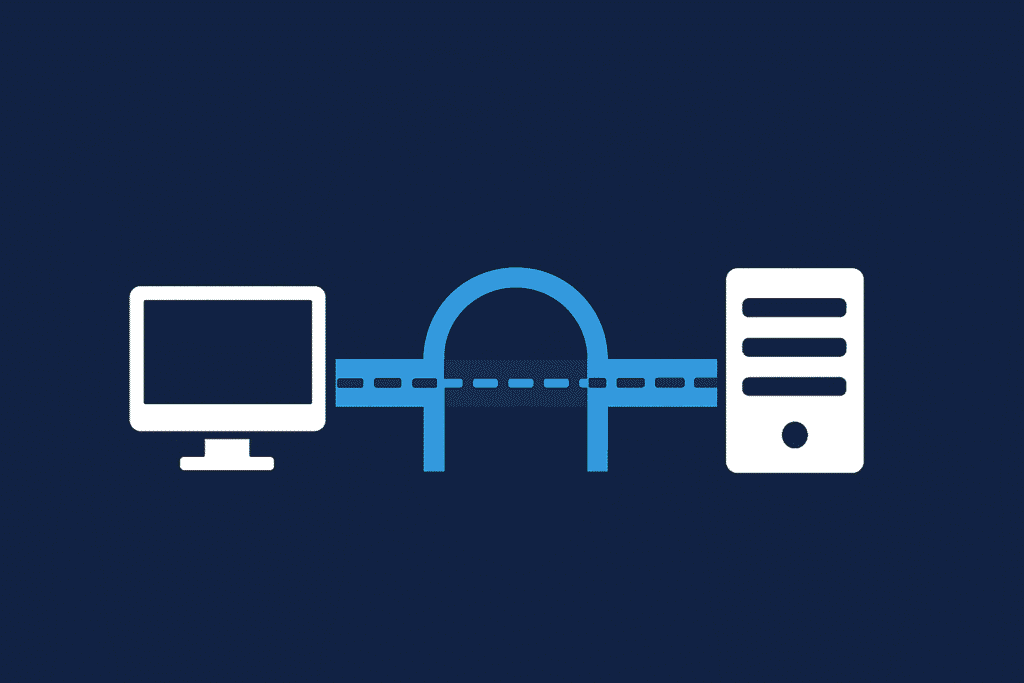

There comes a moment when networking stops looking like tables, ports, and commands—and starts looking like continuity.
When you really understand tunneling, you begin to see that a network connection is not just a technical construct. It is an illusion carefully maintained by agreement, timing, and state.
And once you see that illusion clearly, you cannot unsee it.
The Connection as the Stack Wants It Understood
From the operating system’s point of view, a connection is beautifully simple.
- A TCP connection is a bidirectional byte stream
- Once established, distance is abstracted away
- Latency becomes just the stretchiness of the string
- Packet loss feels like friction on the wire
That “string” may physically pass through:
- Wi-Fi
- Fiber
- Routers
- NAT
- Proxies
- Tunnels inside tunnels
Yet to the two endpoints, none of that matters.
To them, it behaves like one continuous medium.
So yes—conceptually, it is a wire.
How Tunneling Sharpens the Illusion
Tunneling doesn’t invent abstraction.
It reveals it.
Suddenly, the layers expose themselves:
- SSH → TCP carrying TCP
- WireGuard → IP flowing inside UDP
- iodine → IP flowing inside DNS
- Virtual adapters → the OS believes a cable was plugged in
At this point, the illusion becomes undeniable.
There never was a cable.
The cable is an agreement.
What a Connection Really Requires
A connection exists not because of distance or medium, but because:
- Both ends agree on a protocol
- State is maintained
- Time is synchronized enough
- Packets keep arriving in sequence
That’s it.
No magic.
No mystery.
Just coordination.
Virtual Adapters: Where Reality Fully Bends
This is usually the moment people stop and say:
“Wait…”
A virtual adapter means:
- Routing tables change
- Applications bind to it
- IP addresses appear
- ARP exists
- The kernel treats it as real
Now something subtle but profound happens:
- Two machines agree to pretend there is a cable
- The OS builds reality on that pretense
- Applications never question it
At that level, one truth stands out:
Reality is whatever the kernel believes.
That is powerful.
And slightly unsettling.
Closing Thought
Tunneling teaches us that networking is not about paths—it’s about promises.
Once a promise holds, two distant machines behave as if tied together by an invisible string, regardless of distance, medium, or complexity in between.
And once you see that string,
every connection looks different forever.