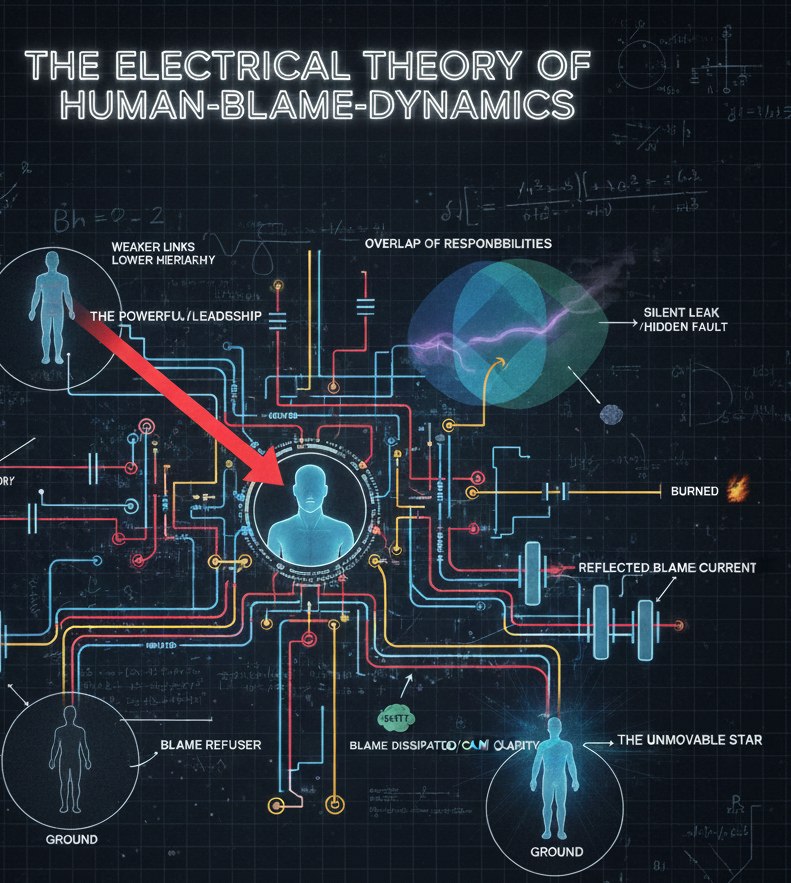

Blame is a powerful current flowing through social systems. Like electricity, it always seeks the path of least resistance — the easiest way to move from one point to another. Unfortunately, in many workplaces and communities, this path often leads to those who are perceived as weaker, less powerful, or simply lower in the hierarchy.
These individuals become the “ground” for blame, absorbing more than their fair share, much like an overloaded electrical circuit. The blame doesn’t just flow randomly — it often acts as a vector, directed at multiple people simultaneously. Yet, the powerful often distort this flow to focus blame on the least powerful, exploiting their fear of retaliation or being labeled “disrespectful” to silence them.
Why Does This Happen?
Because blame must find termination — someone or something to ground it and stabilize the system. When the natural “ground” willingly accepts responsibility, the system remains stable. But when that ground refuses to absorb unfair blame, the current looks for alternative paths — paths often hidden within overlapping responsibilities.
The Theory of Blame Termination and Overlap Currents
These overlaps create what I call “silent leaks” — ambiguous zones where blame silently shifts without confrontation, like a hidden electrical fault or a silent but deadly fart. For example, an accountant might blame a finance officer due to overlapping duties, but blaming an IT professional for a finance-related error is unlikely because there’s no overlap in responsibility.
The key is awareness: when you recognize these silent currents and call them out with valid reason, you restore balance and fairness to the system.
The Role of Boundaries: Your Personal Resistor
Just as resistors regulate current to prevent damage in a circuit, personal boundaries regulate blame currents to protect your mental and emotional wellbeing. Those who stay calm and unmoved in the face of unfair blame act like stable resistors — absorbing only what is fair and letting the rest flow by.
This kind of calm, measured response disarms accusers and often stops the blame cycle from targeting you further.
Deflection and Plausible Deniability
When someone senses their blame might be reflected back — causing them “burns” — they often deflect. They may change the subject, attack unrelated faults (“Why are you answering me back? You’re not obedient!”), or threaten to escalate (“Wait till I tell your boss!”) without ever following through. This tactic diffuses reflected blame currents and protects them from feedback.
Leadership in the Face of Blame
True leverage lies in knowing when to act and when to step back. By owning your part responsibly (“I’m working on it”), without rushing into blame or empty promises, you shift pressure back to the true source of problems. This quiet strength earns respect without drama.
When you become “unmovable, like a distant star,” you radiate calm clarity through chaos — a steady light that guides and stabilizes the system without getting consumed by it.
Final Thoughts
The Electrical Theory of Human-Blame-Dynamics offers a fresh, practical lens to understand social blame:
How blame flows and finds termination
How ambiguous overlaps create silent blame leaks
How boundaries act as vital resistors
How strategic calm and awareness can disarm toxic blame cycles
Seeing human dynamics through this electrical metaphor equips you with tools for resilience, fairness, and leadership — a core part of the philosophy I call The Unorthodox Doctor of Computers.