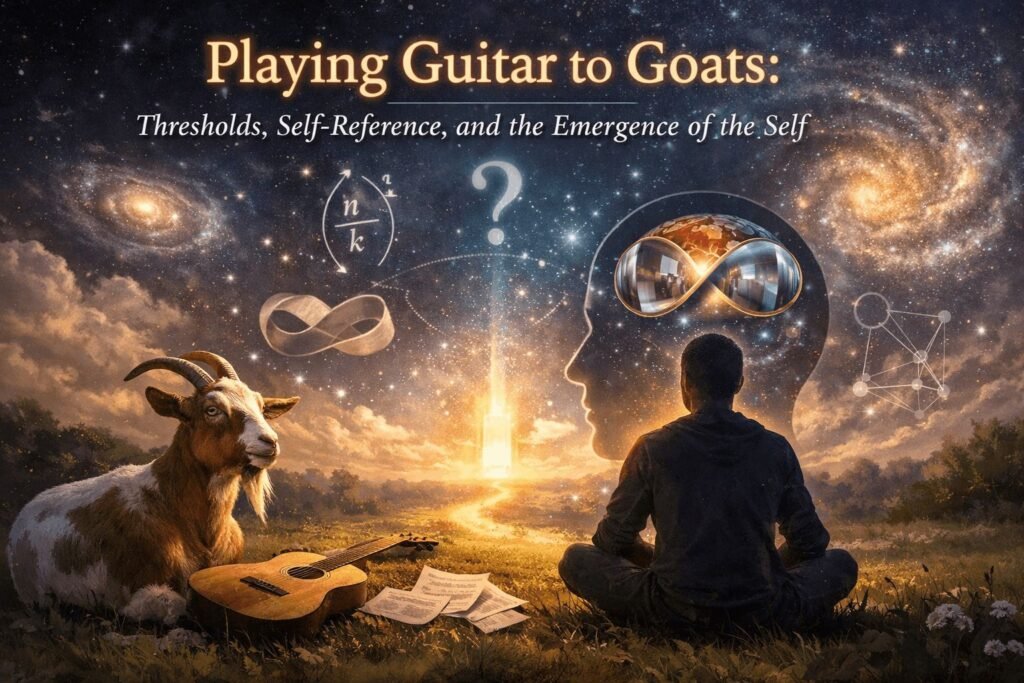

There is a Swahili saying I love:
“Kumpigia mbuzi gitaa.”
Playing a guitar to a goat.
It means trying to explain something to someone who simply has no place to receive it. Not because they are stupid. Not because the explanation is bad. But because the threshold required to understand hasn’t been crossed.
The goat hears sound.
But music has nowhere to land.
This idea turns out to be far deeper than it first appears.
Thresholds of Understanding
Some explanations fail not because they are unclear, but because:
- The listener has not crossed the required cognitive threshold
- The concept has no internal structure to attach to
That’s not arrogance.
That’s how cognition works.
Understanding is not continuous. It is thresholded.
You cannot explain calculus to someone who hasn’t internalized algebra.
You cannot explain entropy without probability.
And you cannot explain certain existential questions to a mind that has not yet reorganized itself enough to host them.
No amount of explanation can substitute for threshold crossing.
Consciousness as a Self-Modeling System
One of the strangest thresholds is consciousness itself—specifically, self-referential consciousness.
The moment that matters is when a system can:
- Represent the world
- Represent itself in the world
- Represent its own representations
That is the moment when questions like these become possible:
- Where did I come from?
- Why is there something rather than nothing?
- What is life?
Anything simpler:
- Can exist
- Can persist
- But cannot ask
This is both astonishing and unsettling. Existence itself does not guarantee the capacity to question existence.
Context, the Self, and the “Untogglable Runtime”
When I was learning mobile application development, I encountered the idea of context—the environment that determines what is valid, accessible, and meaningful.
At some point, I found myself inventing a phrase:
“An untogglable context.”
The self feels exactly like that.
You can switch roles.
You can switch tasks.
You can switch perspectives.
But you cannot exit the context that defines you.
The self is not a thing you possess.
It is the runtime environment in which everything appears.
This is why the self feels both emergent and frightening.
Once it appears, there is no external vantage point from which to step outside it.
Self-Reference and the Feeling of “This Is Crazy”
Self-reference creates loops:
- I think about myself
- Thinking about myself thinking
There is no base case. No external anchor.
This is why self-reference appears in:
- Gödel’s incompleteness theorem
- Recursive computation
- Conscious awareness
- Philosophical vertigo
It feels “crazy” not because it is irrational, but because linear intuition breaks down in circular structures.
You are not breaking reality when you notice this.
You are noticing a fixed point.
A Crucial Clarification: Presence Is Not Eternity
At this point, the mind is tempted to make a leap:
“If consciousness can only experience itself as present, does that mean someone must always exist?”
This feels compelling—but it goes too far.
What is true:
- Whenever the question is asked, an asker exists
What does not follow:
- That the same individual must always exist
From the inside, awareness is always “now.”
But that does not imply personal persistence, return, or inevitability.
Presence is local.
Not eternal.
And that distinction matters.
Why This Is Not Nihilistic
This perspective does not cheapen life.
It does the opposite.
If:
- Consciousness is thresholded
- Self-reference is rare
- Understanding requires reorganization
Then existence is not guaranteed—it is precious.
Meaning does not come from permanence.
It comes from being here at all.
Gratitude for One’s Level
There may be minds that see further than mine.
There may be thresholds I will never cross.
And that’s okay.
Gratitude for one’s current level is not resignation.
It is epistemic maturity.
Every level is a stepping stone—not a verdict.
Final Thought
Some ideas cannot be explained.
They can only be arrived at.
Until then, explaining them is like playing guitar to a goat.
And once the threshold is crossed, the music is impossible to unhear.