
There’s a fascinating pattern I’ve noticed while reflecting on learning, language, and the nature of understanding.
Often, when grappling with complex ideas, it feels like I’m chasing a sense — an intuition — that’s present but just out of reach. I might feel the shape of the idea, but lack the precise words or structure to articulate it. And yet, once the right words or concepts are found, something clicks. Language, in this way, becomes a tool of coordinate transformation — a way to restructure thought, to compress and label what once felt vague or overwhelming.
It’s similar to how a mathematician might substitute a long expression with a simple variable like x. That symbolic handle makes manipulation and exploration possible. Language does something equally powerful: it gives us symbols to hold what the mind alone struggles to contain.
But here’s where it gets even more interesting.
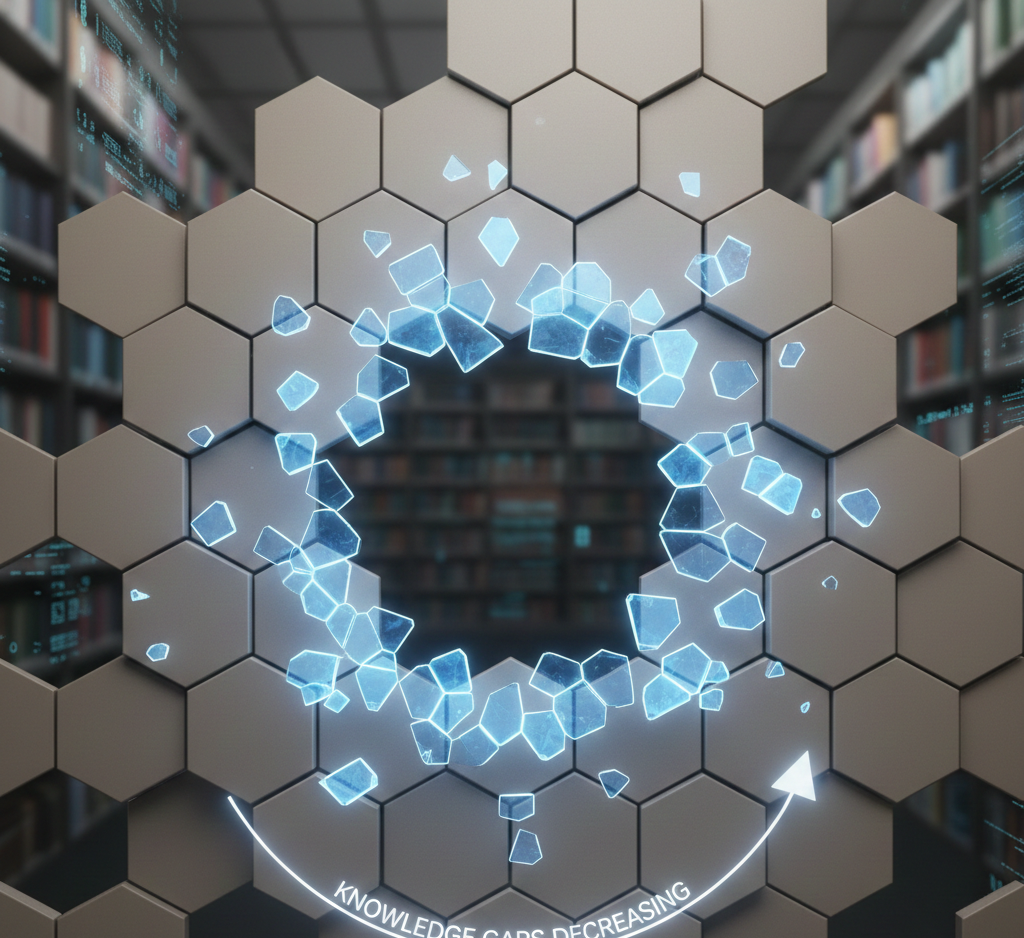
When we learn or discover, we often do so in orders of magnitude. One insight can collapse a massive gap in understanding. But that doesn’t mean the journey is over — a new, finer-resolution gap reveals itself. A gap within the gap. Yet, these new gaps are increasingly subtle, increasingly less impactful. It’s like how, in calculus, we sometimes neglect higher-order terms: they’re there, but their contribution is so small that they can safely be ignored for the purposes at hand.
This, to me, is a metaphor for how we approach knowledge. The more we learn, the more our gaps become indistinguishable from no gaps at all — not because they’ve vanished, but because they’ve shrunk beneath the threshold of our perception. It’s like upgrading a screen from 4K to 8K to 16K. At some point, the human eye can no longer perceive the difference. The extra resolution is real, but irrelevant.
In that sense, understanding isn’t always about reaching a perfect, gapless state. It’s about reaching a functional resolution — a point where the gaps that remain no longer meaningfully hinder insight, communication, or creativity. We might never reach complete knowledge, but we can approach it closely enough that our experience feels whole.
And that, I think, is enough.
Understanding, like vision, doesn’t have to be infinite — just sufficient.