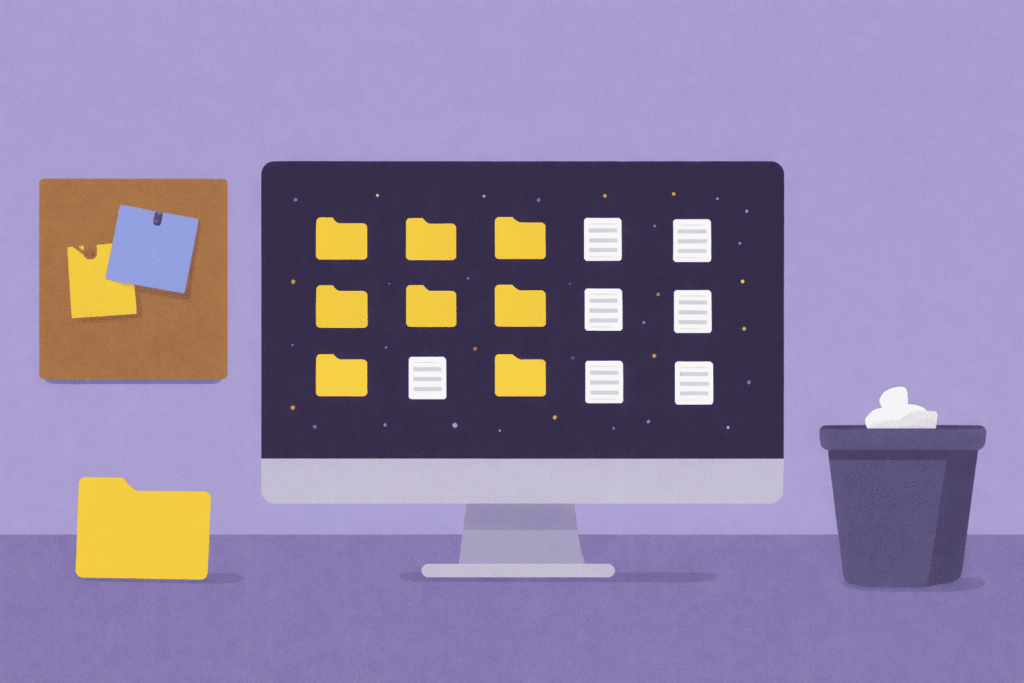

A desktop full of stars becomes unusable.
Icons pile upon icons until nothing can be found, nothing can be acted upon.
The system is alive — busy, even — yet impossible to work with.
And yet, a desktop with nothing on it is equally useless.
It offers no direction, no memory, no momentum.
Cleanliness taken too far becomes emptiness.
This is the quiet lesson most people miss:
The goal is not cleanliness — the goal is usability.
Maintenance is not optional
The same rule applies beyond screens.
Errands, obligations, ideas, half-finished intentions, postponed decisions — all of them behave exactly like desktop icons. Left unattended, they accumulate. Ignored, they overlap. Eventually, they obscure what actually matters.
Cleaning, then, is not destruction.
It is glossing over with care — touching each thing just long enough to decide its place without erasing its value.
This is where many systems fail.
They celebrate production and underestimate maintenance.
But maintenance is not inferior to production.
Without maintenance, production collapses under its own weight.
Creating more while failing to maintain is how systems burn out.
Maintaining without creating is how systems stagnate.
Equilibrium lives between the two.
Structure must not buckle under load
No matter how much work is added, the desktop structure itself should not collapse.
The surface — the top view — should remain usable.
What changes is not the structure, but the depth.
Good systems do not expand outward endlessly; they expand inward.
They distribute complexity vertically rather than letting it spill horizontally.
From the top, you should only see what is actionable now.
Everything else belongs one level deeper.
The desktop is a top view, not the whole reality.
You cannot see everything from the top — and you shouldn’t try to.
To understand more, you either:
- Descend into folders, archives, and projects
- Or elevate your view — zooming out to plans, goals, and intent
That is how structure works.
Clarity at the surface, complexity beneath.
Why baskets matter
Baskets reduce clutter.
Folders, lists, calendars, categories, project spaces — these are not constraints.
They are load-bearing structures.
A good basket does not hide work.
It makes work survivable.
Things placed into baskets are not forgotten; they are contained.
They stop competing for attention while still remaining accessible.
Without baskets, everything fights to stay visible.
With baskets, visibility becomes intentional.
The master basket: the recycle bin
And then there is the master of all baskets:
the trash bin — the recycle bin.
The recycle bin is not an act of cruelty.
It is an act of mercy.
It is where things go when they do not fit into:
- Active work
- Ongoing responsibilities
- Future projections
Importantly, the recycle bin is not always the first stop.
Sometimes, things deserve to be archived first.
Distance before judgment.
Time before deletion.
Archiving acknowledges that something once mattered, even if it no longer does.
Only later, with clarity, do some things earn their final rest in the master bin.
The recycle bin exists so the system does not have to carry everything forever.
Cleaning without erasing yourself
If you never clean your desktop, you eventually cannot use it.
If you clean everything, you erase your own context.
So you must clean without destroying the material being cleaned.
This is not about perfection.
It is about continuity.
Just as the universe is not filled with blinding light,
and just as darkness allows stars to be seen,
space on your desktop — and in your life — is not emptiness.
It is permission to function.
A principle worth keeping
- Clean enough to work
- Keep enough to live
- Structure so growth does not become collapse
Remember this:
Maintenance is not the absence of progress.
It is what allows progress to continue.
The goal is not to eliminate stars —
it is to leave enough space between them so they can still be seen.