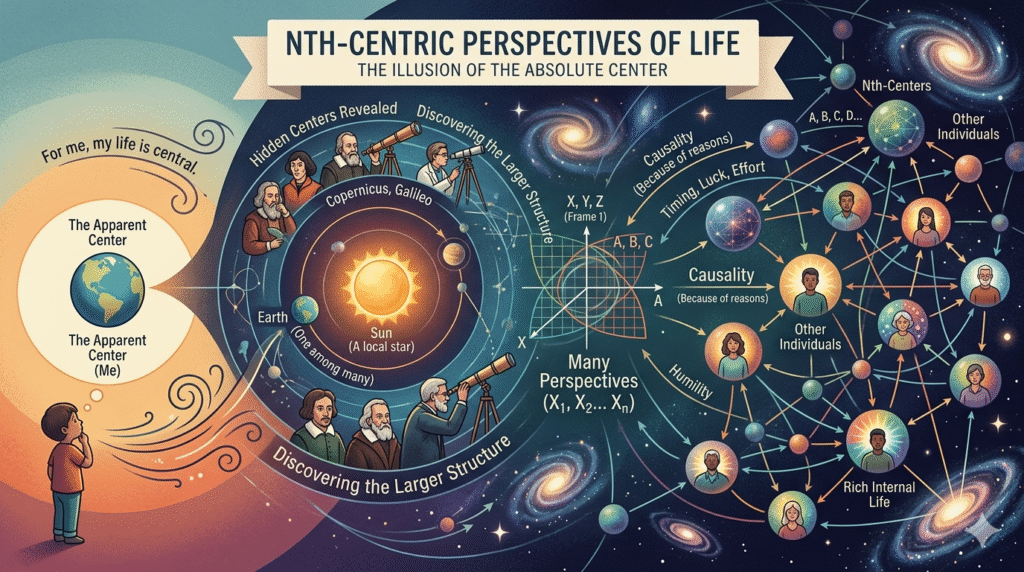

The Illusion of the Absolute Center
There is a recurring pattern that seems to emerge everywhere in human life, mathematics, philosophy, society, and even cosmology: things often appear centered around us until we discover a larger frame.
A child may initially believe that they are the center of attention. The world appears to revolve around their needs, emotions, and existence. But as they grow, they gradually realize that every other person also possesses an inner life, ambitions, fears, insecurities, and priorities.
The same pattern appeared historically in our understanding of the universe.
At one point, humanity believed the Earth was the center of existence. The geocentric model seemed intuitive because the heavens visibly revolved around us. But later, through the work of people like Copernicus and Galileo, we discovered that the Earth itself was merely another object orbiting the Sun.
Humanity was not malicious for believing otherwise. The belief emerged naturally from a limited frame of observation.
Perhaps much of human thinking operates similarly.
We repeatedly discover that what once appeared central is actually part of a much larger structure.
Things Happen Because Of, Not For
I have increasingly come to think that events do not necessarily happen for a reason, but rather because of reasons.
There is an important distinction between those two statements.
To say something happens for a reason often implies purpose, destiny, intention, or narrative meaning.
To say something happens because of reasons implies causality.
Rain does not fall for emotional fulfillment.
Stars do not explode for character development.
Success does not occur because the universe decided someone deserved it.
Instead, outcomes emerge from interactions between countless variables:
- timing,
- opportunity,
- probability,
- social structures,
- genetics,
- effort,
- luck,
- environment,
- and conditions.
The universe does not appear to possess emotional obligations toward human expectations.
This does not make existence meaningless.
Rather, it suggests that reality may operate through structure and causality rather than narrative intention.
Success and the Fragility of Outcomes
People often look at highly successful individuals and assume that success is purely the result of discipline, intelligence, or superior thinking.
But success appears to be far more delicate than that.
Two individuals may possess comparable talent, determination, and intelligence, yet arrive at radically different outcomes simply because one encountered:
- better opportunities,
- stronger social connections,
- favorable timing,
- economic stability,
- mentorship,
- or fortunate circumstances.
Hard work matters.
Learning matters.
Persistence matters.
But outcomes also depend on conditions that no individual fully controls.
Recognizing this does not mean effort is pointless.
Instead, it introduces humility.
Failure is not always proof of inadequacy.
Success is not always proof of superiority.
Sometimes reality is simply the product of many interacting variables converging differently.
Hidden Centers and Changing Perspectives
Mathematics provides surprisingly powerful parallels to human perspective.
Imagine looking at a complicated shape or system for the first time. At first, everything may appear chaotic, confusing, or difficult to interpret. But sometimes, simply changing the angle, the frame of reference, or the method of interpretation suddenly reveals an underlying pattern.
The structure itself did not change.
Only the perspective changed.
Human understanding often works the same way.
People frequently mistake their current viewpoint for absolute truth, when in reality they are simply observing the world from one position among many.
A person may think they fully understand a situation, only to later discover that another perspective completely changes the meaning of what they originally believed.
The same pattern appears throughout history.
At one point, humanity believed the Earth was the center of existence because that interpretation seemed natural from everyday observation. Later discoveries revealed a much larger and more complex structure.
Perhaps many aspects of life work similarly.
What appears central today may later become just one part of a much broader system.
Many Perspectives, One Larger Structure
A useful way to think about life is to imagine that reality contains many different perspectives existing simultaneously.
Every individual experiences themselves as the center of their own world:
- their emotions feel immediate,
- their problems feel urgent,
- their ambitions feel important,
- and their experiences feel uniquely significant.
But every other person is also experiencing life from their own internal center.
This creates a fascinating tension.
From our own perspective, we often feel like the main character of reality. Yet from a broader point of view, we are also one person among billions of others who possess equally rich internal lives.
No single perspective fully captures the entirety of reality.
Instead, the world may be better understood as a network of overlapping viewpoints, each revealing part of a larger structure.
This does not make individual experience meaningless.
Rather, it suggests that understanding becomes deeper when we recognize that multiple centers can coexist at the same time.
Solving for Yourself
There is another fascinating mathematical analogy hidden inside algebra.
When we solve for a variable, we isolate it.
x = f(a,b,c,d…)
The variable on the left side becomes clean, isolated, and neatly defined.
Meanwhile, the right side absorbs all the complexity:
- mixtures,
- coefficients,
- interactions,
- divisions,
- powers,
- and entanglements.
In many ways, human beings psychologically do something similar.
People often attempt to preserve a simplified image of themselves:
- “I am justified.”
- “I am rational.”
- “I am innocent.”
- “I am correct.”
To maintain this neat identity, complexity and contradictions are frequently externalized into the surrounding world.
The result is that the self remains isolated and manageable while the collective system absorbs the disorder.
This resembles the social phenomenon often called “saving face.”
The clean variable on the left side may only exist because the mess has been transferred elsewhere.
But perspective is reversible.
Someone else can solve the same equation differently:
y = g(x,a,b,c…)
Now the previously isolated variable becomes entangled on the right side.
There is no permanently privileged variable.
Only changing frames of interpretation.
The Indifference of Reality
One of the most difficult ideas for human beings to accept may be the possibility that reality is fundamentally indifferent.
Not hateful.
Not malicious.
Not cruel.
Indifferent.
Gravity does not reward virtue.
An earthquake does not distinguish innocence from guilt.
A black hole does not care about dreams.
Evolution does not optimize for fairness.
And yet, despite this apparent indifference, human beings continuously create meaning:
- through relationships,
- through art,
- through science,
- through compassion,
- through understanding,
- and through shared existence.
Perhaps meaning is not something imposed externally onto the universe.
Perhaps meaning is something conscious beings construct locally within it.
The Nth-Centric Perspective
The phrase “nth-centric” represents the idea that there may not be one absolute center.
Instead:
- every observer occupies a local frame,
- every system contains multiple interacting perspectives,
- and every center may itself become peripheral when viewed from a larger coordinate system.
The child is not the center.
The Earth is not the center.
Humanity may not be the center.
And yet, from within each local frame, centrality still feels real.
Perhaps wisdom is not the destruction of perspective, but the recognition that many perspectives can coexist simultaneously.
Reality may therefore be less like a single point and more like an interconnected structure of infinitely shifting centers.
An nth-centric universe.
Final Reflection
Human beings naturally search for certainty, narrative purpose, and centrality.
But mathematics, philosophy, and science repeatedly reveal a deeper pattern:
the world is larger, more interconnected, and less centered around us than we first imagined.
And strangely, that realization does not necessarily diminish humanity.
It may instead deepen humility.
For perhaps the most remarkable thing is not that we are the center of existence, but that conscious beings emerged at all inside a universe vast enough to continuously transcend their understanding.