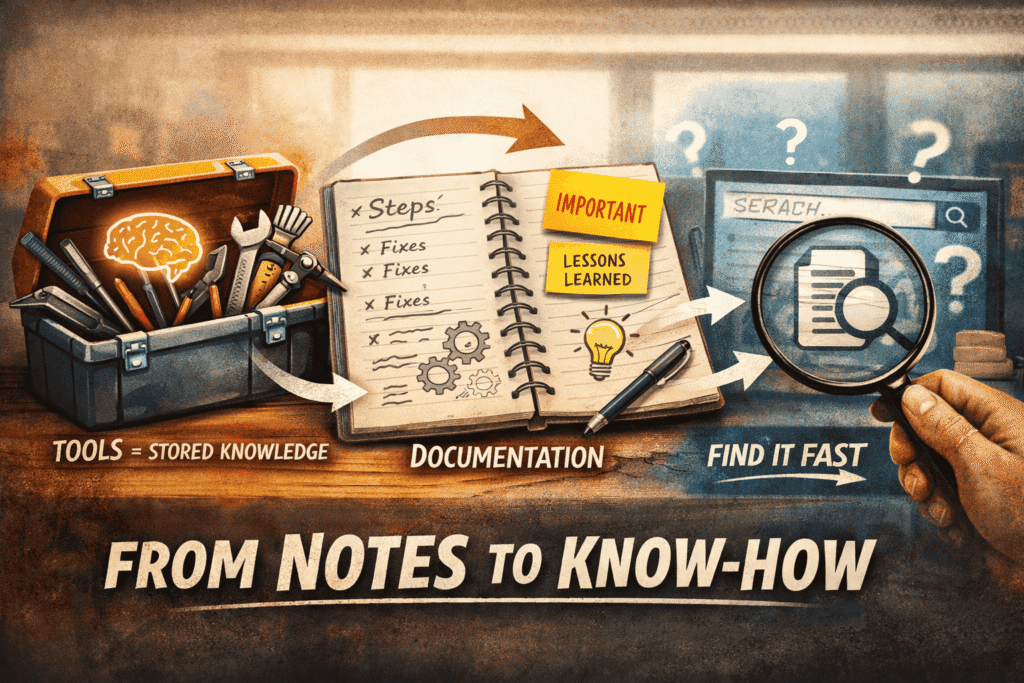

We often assume documentation is about writing things down so we don’t forget. But experience shows a deeper truth: most documentation does not fail because it was never written — it fails because it cannot be found.
The real problem is not storage.
It is retrieval.
Documentation, therefore, is best understood as a retrieval problem disguised as a writing task.
The Illusion of Saved Knowledge
A familiar scenario illustrates this.
You solve a complex problem — perhaps troubleshooting a stubborn appliance, repairing a leaking faucet, rewiring a lamp, or handling a tricky work task. These tasks are mentally demanding because they involve trial, error, testing, and reasoning to get everything just right.
Often, you might consult a tutorial video or instructions for a similar scenario, then adapt the steps through experimentation until the task works for your situation. Once successful, you document the exact steps that worked, compressing that exploratory process into a refined procedure.
Weeks later, the same issue reappears. You remember solving it before. You even remember taking notes. But now a different difficulty emerges:
- Where did you save the file?
- What did you name it?
- Which folder or drawer contains it?
- What keyword will surface it?
The knowledge exists, yet it feels lost.
Knowledge that cannot be retrieved is indistinguishable from knowledge never acquired.
Why Many People Skip Documentation
Reluctance to document is a behavioral problem as much as a technical one.
Many people skip writing notes because they feel rushed or believe the problem is uncommon. They think, “I’ll never need this again,” or “I’ll remember it next time.”
This blind optimism is often worse than healthy skepticism or careful scrutiny. People underestimate the future cost of cognition — the mental effort required to rediscover or redo a problem later.
Even problems that occur infrequently — say once a year — can become much harder to solve if documentation is missing. Without proper labeling, indexing, and storage, a rare problem may return stronger, catching you off guard.
Slowing down just enough to document or perform a lessons-learned phase is not wasted time. It’s preemptive investment that reduces future mental strain and prevents repeated mistakes.
Documentation as Cognitive Snapshotting
Good documentation is a form of cognitive checkpointing.
It captures:
- Context — why the task mattered
- Steps — what you actually did
- Pitfalls — what went wrong and how you fixed it
- Environment — the conditions or tools used
These snapshots allow your future self to re-enter a past mental state without recomputing the entire solution. Without snapshots, recurring problems become fresh explorations — a random walk through a search space already pruned once.
Documentation is time travel for cognition.
Tools as Stored Knowledge
Tools themselves are a form of documentation. Each tool represents stored cognitive effort: someone else’s problem-solving distilled into a reusable artifact.
Using tools effectively is a cognitive task in itself. A problem often becomes:
- Which tool to use?
- In what sequence?
- Should it be combined with another tool?
Order matters. Tool A followed by Tool B might produce a desired effect, while the reverse order might fail or be less efficient. Sometimes multiple sequences work, but one is optimal.
In this way, tools are compressed expertise: pre-computed solutions ready for reuse. Your task is to identify the right tool or combination for your context — and to remember or document that choice for future retrieval.
The Structural Problem with Folders
Many people store notes in folders or notebooks, but this introduces friction. A note might be filed under “Repairs,” “Electronics,” or “Incidents.” Real problems often belong to multiple contexts, but most storage systems allow only one.
This mismatch creates retrieval friction and classification regret — even if the information exists, finding it can feel impossible.
Naming and Keywords: The Real Keys
The way you label your notes matters as much as the content.
- “Leaky kitchen faucet repair – step by step” is better than “DIY_notes.docx.”
- “Office wiring troubleshooting – sequence of steps” is better than “work_notes.txt.”
Good names act as indexes that guide your memory and help search tools work effectively. Naming is compression plus indexing.
Documentation as Knowledge Compression
When documenting a solved problem, you compress a long trial-and-error process into a concise guide:
- Removing false branches
- Eliminating redundant steps
- Preserving what actually works
Future retrieval then unlocks this compressed expertise instantly. Documentation is externalized problem-solving.
Cognitive Outsourcing: When Retrieval Fails
When documentation fails, people often resort to cognitive outsourcing.
A DIYer or worker encountering a rare problem previously solved but poorly documented may:
- Call a colleague or friend
- Look for a professional
- Ask someone “who knows”
- Wait for external assistance
This is rational. Recomputing the solution may be more costly than transferring the problem to someone with compressed expertise. Poor documentation doesn’t just waste time — it shapes our behavior and reliance on others.
Teaching Your Future Self
Documentation resembles teaching, except the learner is your future self.
Good documentation assumes forgetting, reconstructs context, and anticipates confusion. Bad documentation assumes memory continuity.
Documentation is future-self empathy.
From Storage-Centric to Retrieval-Centric Notes
A retrieval-focused approach emphasizes:
- Descriptive titles
- Keyword embedding
- Context-first writing
- Search-friendly structure
- Reduced reliance on deep folder hierarchies
Tools like Everything demonstrate this digitally, but the principle applies to any note-taking system: make finding information effortless.
Storage answers where.
Retrieval answers how to find.
A New Definition
Documentation can be reframed as:
Lossless cognitive snapshot compression optimized for uncertain future retrieval.
It transforms passive note-taking into a system that preserves past problem-solving and reduces future mental effort.
Closing Reflection
Every solution you develop — whether in DIY, work, or using tools to solve complex tasks — is expensive mental computation. Documentation preserves that effort.
But a note isn’t truly complete until you can rediscover it months later under vague memory.
Documentation is not a writing problem.
It is a retrieval problem — and solving it converts experience into enduring expertise.